
PHP powers a large share of the web, and Laravel is one of its most widely adopted frameworks. Teams building event-driven services, background workers, and microservice boundaries in Laravel need messaging that is fast, simple to operate, and easy to wire into familiar Laravel patterns: facades, service providers, queue workers, Artisan commands, and configuration via .env.
Laravel NATS is an open source package that brings NATS and JetStream into Laravel applications without forcing developers to re-learn their framework. It wraps the basis-company/nats PHP client with Laravel-native configuration, a JSON message envelope, queue drivers, JetStream helpers, and production-oriented features such as idempotency, observability hooks, and optional subject ACLs.
This post walks through why the package exists, what it offers, and how it fits into the broader NATS ecosystem.
Why Laravel Teams Choose NATS
Modern Laravel applications rarely live in isolation. A typical stack might include:
- HTTP APIs that emit domain events when orders are placed or payments are captured
- Horizon or
queue:workprocesses that handle retries and failure tracking - Multiple services that must stay loosely coupled while sharing a reliable event backbone
NATS fits this model well. It is lightweight, supports pub/sub and queue groups out of the box, and JetStream adds persistence, replay, and deduplication when you need stronger delivery guarantees. For teams already running NATS for Go, Node.js, or Python services, adding a Laravel service that speaks the same protocol avoids operating a second message broker.
The challenge for PHP developers is not NATS itself. It is integrating NATS cleanly with Laravel conventions: configuration, dependency injection, queue semantics, logging, and deployment tooling.
That is the gap Laravel NATS fills.
Why Use the Laravel NATS Package
Building a custom NATS integration in every Laravel project repeats the same work: connection pooling, envelope conventions, graceful shutdown, health checks, and safe configuration for production. Laravel NATS centralizes that effort into a maintained library with documentation, CI, and semver stability.
Laravel-native developer experience
Install with Composer, publish config, and use the NatsV2 facade. The package registers a service provider, merges sensible defaults, and exposes Artisan commands for listening, JetStream operations, config validation, and connectivity checks. You stay inside patterns Laravel developers already know.
Two tracks with a clear migration path
The package supports a recommended v2 stack (NatsV2 on basis-company/nats) and a legacy stack (Nats on the package’s native wire client). Existing workloads keep running while new code adopts NatsV2. There are no silent removals in minor releases; migration is documented in the package’s Migration Guide.
Production features beyond pub/sub
From package 1.4.0 onward, Laravel NATS ships idempotency middleware, publish metrics hooks, correlation headers, and a nats_basis queue driver. From 1.5.0, optional boot-time config validation, TLS production guards, and client-side subject ACLs help teams catch misconfiguration before traffic hits NATS. From 1.6.0, W3C trace context propagation, subject-prefix connection routing, and a transactional outbox recipe round out advanced integration patterns.
Quality and compatibility
The package targets PHP 8.2+, Laravel 10 through 13, and NATS Server 2.x. CI runs Pest tests, PHPStan at level 9, Pint, and PHP-CS-Fixer. Integration tests use Docker NATS, matching how teams run NATS locally.
How Laravel NATS Contributes to the NATS Ecosystem
NATS succeeds because client libraries and framework integrations lower the cost of adoption across languages and platforms. Laravel NATS extends that reach into one of PHP’s largest communities.
Expanding the PHP client surface
The package builds on basis-company/nats, a modern PHP NATS client. Laravel NATS does not replace that client; it documents and exercises it in real application contexts: Laravel queues, middleware pipelines, multi-connection routing, and JetStream stream provisioning. That feedback loop helps PHP remain a first-class citizen in polyglot NATS deployments.
Enabling polyglot event backbones
When a company standardizes on NATS, Laravel services can publish and subscribe using the same subjects, headers, and JetStream streams as Go or Node.js workers. The package’s JSON envelope (id, type, version, data) gives cross-language consumers a predictable payload shape. Correlation headers (X-Request-Id, Nats-Correlation-Id) and optional W3C traceparent propagation align Laravel traces with the rest of the mesh.
Operational patterns the ecosystem expects
Health checks via php artisan nats:ping, config validation for CI pipelines, reconnect helpers after dropped sessions, and optional metrics bindings (NatsMetricsContract) mirror practices NATS users expect from mature clients in other languages. Teams operating mixed stacks get consistent operational tooling rather than a one-off PHP script.
Open source and community contribution
Laravel NATS is MIT licensed and welcomes issues and pull requests on GitHub. Documentation is index-first under docs/v2/, with copy-paste examples for subscribe, queue groups, ACL, reconnect, outbox, trace context, request/reply, and idempotency. That lowers the barrier for Laravel developers to participate in the NATS community and share production patterns.
Architecture at a Glance
The v2 stack is a thin Laravel wrapper around Basis\Nats\Client. Your application code talks to NatsV2; the gateway delegates to publishers, subscribers, and connection management; the basis client handles the NATS wire protocol.
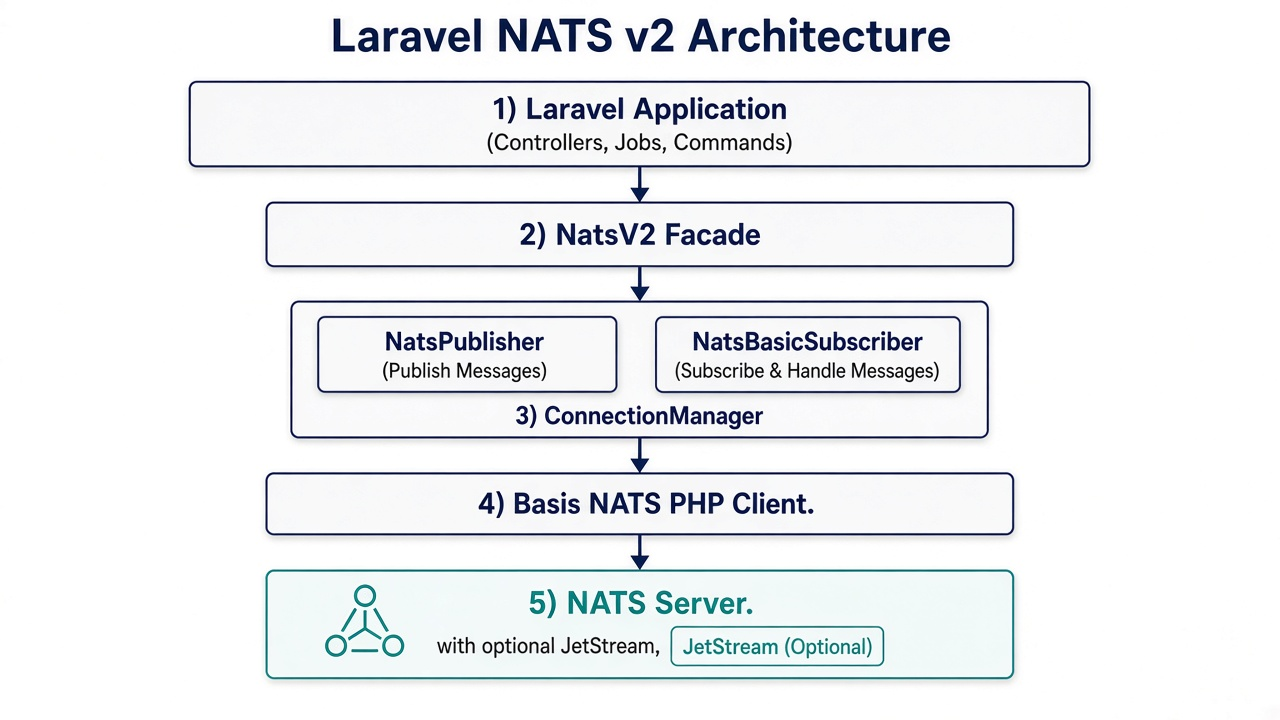
At a high level:
- Configuration lives in
config/nats_basis.php(env-driven, publishable). ConnectionManagercaches named connections and supports seed lists, TLS, and reconnect.NatsPublisherwraps publish with the JSON envelope, headers, ACL checks, and optional metrics.- Subscriber API registers PHP callables that receive
InboundMessagevalue objects, with middleware and events. - Queue driver
nats_basisreuses the same connection stack for Laravel background jobs.
Getting Started
Requirements
- PHP 8.2+ (PHP 8.3+ for Laravel 13)
- Laravel 10.x, 11.x, 12.x, or 13.x
- NATS Server 2.x (JetStream enabled when using stream features)
Install and configure
composer require zaeem2396/laravel-nats
php artisan vendor:publish --tag=nats-config
Match your .env to your NATS endpoint:
NATS_HOST=127.0.0.1
NATS_PORT=4222
NATS_USER=
NATS_PASS=
NATS_TOKEN=
For local development, the package repository includes a docker-compose.yml that starts NATS with a single command:
docker compose up -d
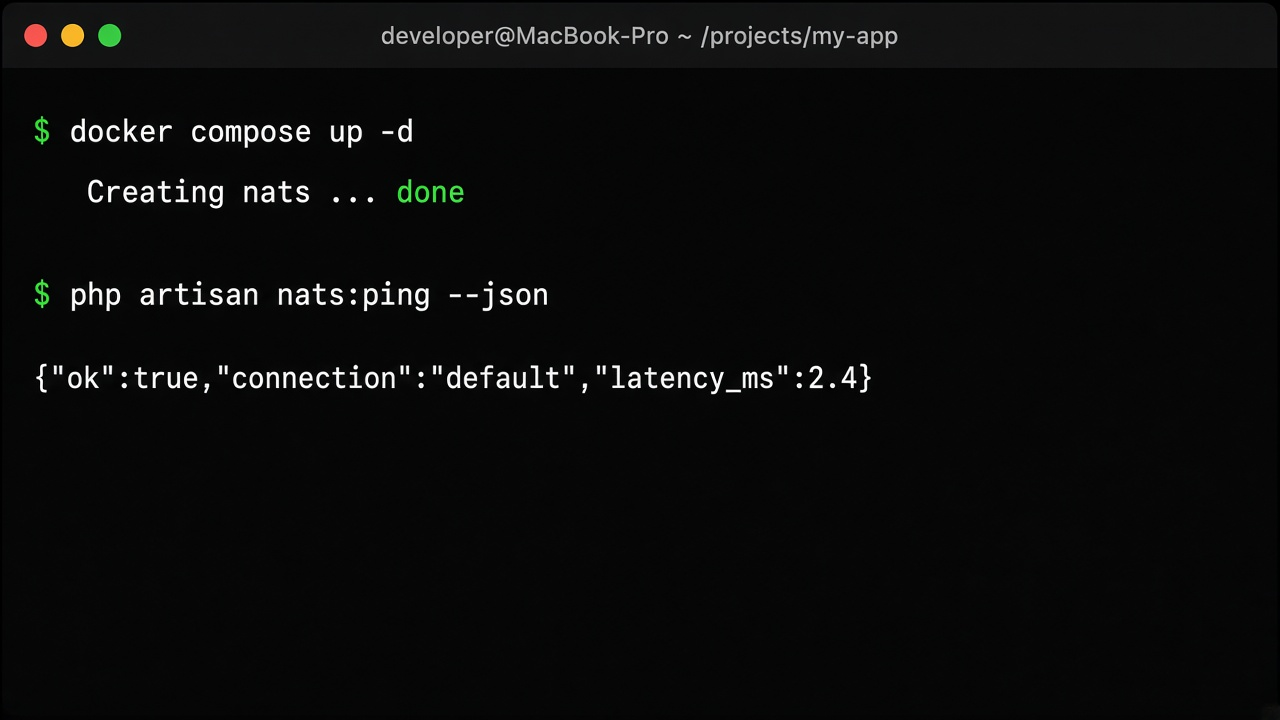
Verify connectivity:
php artisan nats:ping --json
Core Messaging with NatsV2
Publish with a structured envelope
NatsV2::publish() serializes payloads into a versioned JSON envelope. Every message gets a unique id, the subject as type, a configurable version, and your application data under data. Non-empty headers are sent as HPUB on the wire.
use LaravelNats\Laravel\Facades\NatsV2;

NatsV2::publish(
    'orders.created',
    ['order_id' => 123, 'total' => 4999],
    ['X-Request-Id' => 'req-abc-123'],
);
The resulting envelope on the wire looks like:
{
  "id": "550e8400-e29b-41d4-a716-446655440000",
  "type": "orders.created",
  "version": "1",
  "data": {
    "order_id": 123,
    "total": 4999
  }
}
This convention helps polyglot consumers: a Go or Python subscriber can decode the same shape without Laravel-specific serialization.
Subscribe and process messages
Subscriptions register a PHP callable. The basis client is pull-based, so you call process() in a loop (or use the Artisan listener command).
use LaravelNats\Laravel\Facades\NatsV2;
use LaravelNats\Subscriber\InboundMessage;

NatsV2::subscribe('orders.created', function (InboundMessage $message): void {
    $payload = $message->envelopePayload();
    logger()->info('Order received', (array) $payload);
});

while ($running) {
    NatsV2::process(null, 1.0);
}
For development and debugging, use the built-in listener:
php artisan nats:v2:listen orders.created --timeout=1
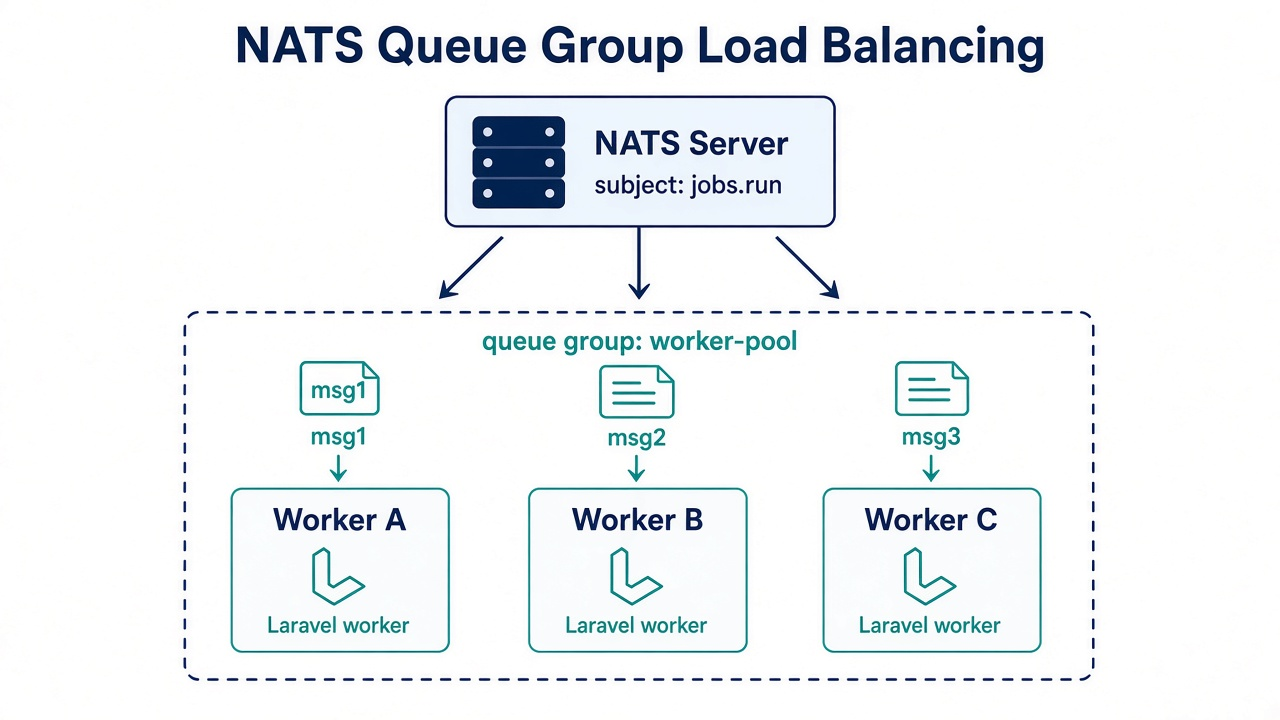
Queue groups for load-balanced consumers
Pass a queue group name as the third argument to subscribe() for NATS queue semantics. Only one member of the group receives each message.
NatsV2::subscribe('jobs.run', $handler, 'worker-pool');
JetStream Integration
From package 1.4.0, JetStream on the v2 stack uses Basis\Nats\Api, Stream, and Consumer from the basis client. Laravel NATS adds facade helpers, stream presets in config, and Artisan commands.
Publish to a stream
use LaravelNats\Laravel\Facades\NatsV2;

NatsV2::jetStreamPublish(
    stream: 'ORDERS',
    subject: 'orders.created',
    payload: ['id' => 1],
    useEnvelope: true,
    waitForAck: true,
);
Pull consumers
foreach (NatsV2::jetStreamPull('ORDERS', 'worker-1', batch: 5) as $msg) {
    // Process $msg, then ack explicitly
    $msg->ack();
}
Stream provisioning and CLI
Define presets under nats_basis.jetstream.presets and provision from Artisan:
php artisan nats:v2:jetstream:info
php artisan nats:v2:jetstream:streams
php artisan nats:v2:jetstream:provision example_events
php artisan nats:v2:jetstream:pull ORDERS worker-1
JetStream gives Laravel applications durable, replayable event logs alongside Core NATS pub/sub, which suits audit trails, event sourcing light, and at-least-once processing with explicit ack/nak control.
Laravel Queue on NATS
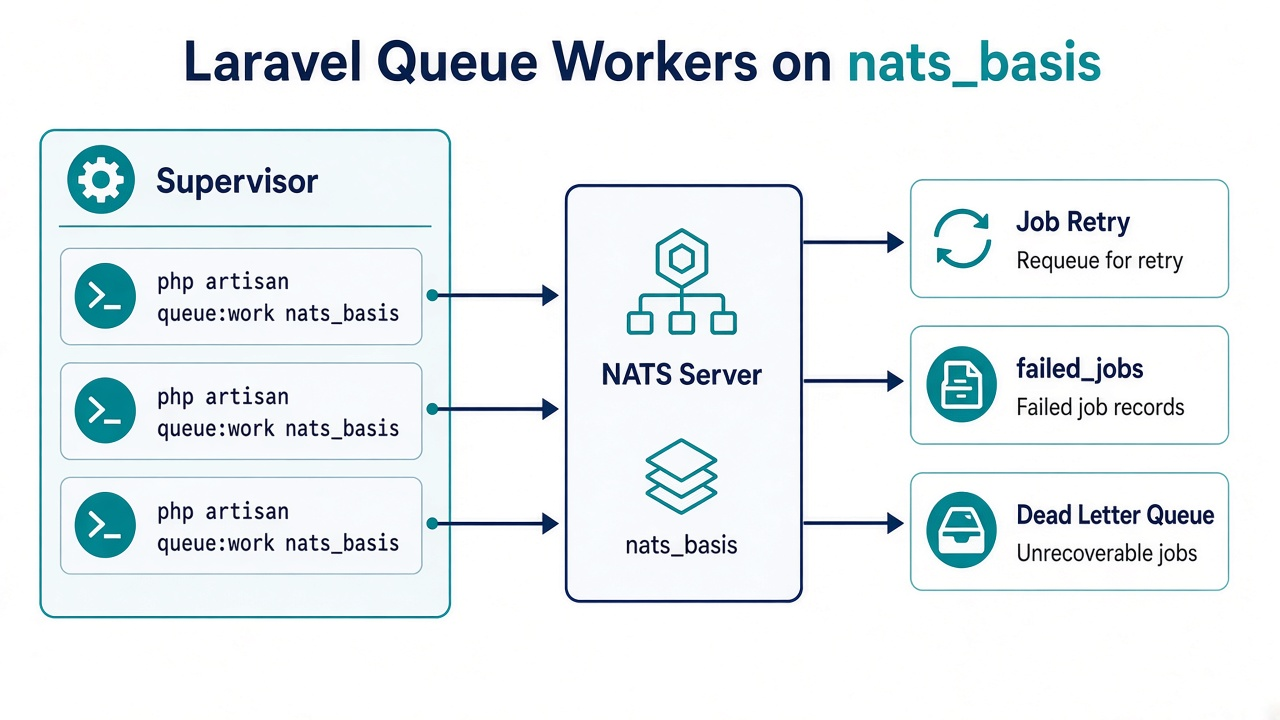
Laravel NATS provides two queue drivers:
| Driver | Client | When to use |
|---|---|---|
nats | Legacy Core\Client | Existing legacy workloads |
nats_basis | Basis\Nats\Client | New and migrated workers (recommended) |
Configure nats_basis in config/queue.php:
'connections' => [
    'nats_basis' => [
        'driver' => 'nats_basis',
        'queue' => env('NATS_BASIS_QUEUE', 'default'),
        'retry_after' => 60,
        'tries' => 3,
        'prefix' => env('NATS_BASIS_QUEUE_PREFIX', 'laravel.queue.'),
        'dead_letter_queue' => env('NATS_BASIS_QUEUE_DLQ'),
    ],
],
Dispatch jobs as usual:
ProcessOrder::dispatch($order)->onConnection('nats_basis');
Run workers with standard Laravel commands:
php artisan queue:work nats_basis --queue=default --tries=3
The driver supports dead letter queue routing, per-process max_in_flight limits, and the same retry and failed_jobs semantics Laravel developers expect. Job payloads use a stable JSON shape compatible with the legacy nats driver, which simplifies migration.
Subscriber Middleware and Events
The subscriber pipeline supports middleware, similar in spirit to HTTP middleware. Register classes under nats_basis.subscriber.middleware:
| Middleware | Purpose |
|---|---|
LogInboundMiddleware | Debug logging of inbound messages |
CorrelationLogInboundMiddleware | Propagate request and correlation IDs into log context |
RedactedEnvelopeLogInboundMiddleware | Log envelope metadata with redacted data fields |
IdempotencyInboundMiddleware | Skip duplicate handler invocations when an idempotency key is present |
Enable Laravel events with NATS_SUBSCRIBER_DISPATCH_EVENTS=true to fire NatsInboundMessageReceived before your handler runs. That is useful for global metrics or auditing without changing every callback.
Idempotency for At-Least-Once Workloads
Retried publishes, redelivered JetStream messages, and duplicate HTTP callbacks are common in distributed systems. Laravel NATS supports optional idempotency keys on publish and deduplication on subscribe.
Publish with an idempotency key
Include idempotency_key in the payload. The publisher strips it from data, places it on the envelope root, and mirrors it as an HPUB header (default Nats-Idempotency-Key):
NatsV2::publish('payments.captured', [
    'idempotency_key' => 'pay_evt_' . $paymentId,
    'payment_id' => $paymentId,
    'amount' => 1000,
]);
Subscribe with deduplication middleware
NATS_IDEMPOTENCY_ENABLED=true
NATS_IDEMPOTENCY_TTL=86400
NATS_IDEMPOTENCY_CACHE_STORE=redis
Register IdempotencyInboundMiddleware in config. When a duplicate key arrives within the TTL, the handler is not invoked. Use a shared cache store (Redis) in production so all worker processes share reservations.
This pattern complements JetStream’s server-side deduplication (Nats-Msg-Id header): application-level idempotency protects your business logic even when the transport layer cannot deduplicate on its own.
Observability and Correlation
Publish metrics
Rebind NatsMetricsContract to emit counters and histograms to Prometheus, OpenTelemetry, or StatsD:
use LaravelNats\Observability\Contracts\NatsMetricsContract;

$this->app->singleton(NatsMetricsContract::class, YourMetricsImplementation::class);
When NATS_OBSERVABILITY_METRICS=true, the publisher records laravel_nats.publish.total with connection and outcome labels. Optional latency histograms are available via NATS_OBSERVABILITY_PUBLISH_LATENCY_MS.
Correlation across HTTP and NATS
When NATS_CORRELATION_INJECT=true, NatsV2::publish() copies X-Request-Id and Nats-Correlation-Id from the current HTTP request into HPUB headers. Subscribers read them via InboundMessage::requestId() and correlationId().
Build headers fluently with NatsHeaderBag:
use LaravelNats\Support\NatsHeaderBag;

$headers = NatsHeaderBag::make()
    ->withRequestId('req-1')
    ->withCorrelationId('corr-1')
    ->withIdempotencyKey('idem-1')
    ->toArray();

NatsV2::publish('orders.created', ['order_id' => 123], $headers);
Health checks
Use php artisan nats:ping in deploy scripts or expose a readiness route that returns 503 when NATS is unreachable. Pair this with Laravel’s scheduler and your existing load balancer health probes.
Security and Production Hardening
Client-side controls do not replace NATS server authentication and authorization. They reduce configuration mistakes in application code.
Boot-time validation
NATS_BASIS_VALIDATE_CONFIG=true
The service provider validates connection rows on boot: non-empty host, valid port range, positive timeout. Invalid config throws NatsConfigurationException so the app fails fast.
Run the same checks in CI:
php artisan nats:v2:config:validate
TLS in production
When NATS_TLS_REQUIRE_IN_PRODUCTION=true and APP_ENV=production, each connection must specify TLS material (CA file, client cert/key, or tlsHandshakeFirst). This prevents accidental plaintext-only settings in production.
Subject ACL allowlists
NATS_ACL_ENABLED=true
NATS_ACL_PUBLISH_PREFIXES=orders.,billing.
NATS_ACL_SUBSCRIBE_PREFIXES=orders.,events.
NatsPublisher, BasisJetStreamPublisher, and NatsBasisSubscriber enforce prefix rules before wire operations. Trailing dots denote prefix matches (orders. allows orders.created but not orders alone).
Note: the nats_basis queue driver publishes directly via the basis client, so ACL does not cover queue subjects. Restrict those with NATS server authorization and careful queue prefix configuration.
Advanced Features (v2.7)
W3C trace context
Propagate traceparent and tracestate from HTTP requests into NATS headers for distributed tracing:
NATS_TRACE_CONTEXT_INJECT=true
$headers = NatsHeaderBag::make()
    ->withTraceContext(
        '00-4bf92f3577b34da6a3ce929d0e0e4736-00f067aa0ba902b7-01',
        'rojo=00f067aa0ba902b7',
    )
    ->toArray();

NatsV2::publish('orders.created', ['order_id' => 123], $headers);
Subscribers read trace context via $message->traceParent() and $message->traceState().
Subject-prefix connection selection
Route subjects to named NATS clusters without passing a connection argument on every call:
NATS_CONNECTION_SUBJECT_PREFIXES="orders.eu.:orders-eu,orders.:orders,billing.:billing"
Longest prefix wins. Explicit connection: arguments still override the selector.
Transactional outbox
The outbox recipe keeps storage in your application while the package provides DTOs and a dispatcher:
$result = NatsV2::dispatchOutbox(app(DatabaseNatsOutboxStore::class));

logger()->info('NATS outbox drained', [
    'published' => $result->published(),
    'failed' => $result->failed(),
]);
Insert outbox rows in the same database transaction as your business write, then drain them from a scheduled Artisan command. That gives you atomicity between your database and NATS publishes without two-phase commit.
Request/reply and reconnect
NatsV2::request() performs synchronous request/reply with timeout and no-responder handling. From 1.6.2, NatsV2::reconnect() drops cached clients after a dropped session and opens a fresh connection. NatsV2::drainConnection() runs process() for a bounded time before disconnecting, useful for graceful shutdown in long-running workers.
try {
    $reply = NatsV2::request('inventory.check', ['sku' => 'ABC-123'], timeout: 2.0);
} catch (NatsNoRespondersException $e) {
    // No subscriber available
} catch (NatsRequestTimeoutException $e) {
    // Timed out waiting for reply
}
Dual Stack and Migration
Teams with existing Laravel NATS integrations on the legacy Nats facade and nats queue driver can migrate incrementally:
- Adopt
NatsV2for new publish and subscribe code. - Move queue workers to
nats_basiswhen ready. - Switch JetStream workflows to
NatsV2::jetstream()helpers. - Enable security validation and ACL as you harden production.
Legacy APIs remain supported; the Migration Guide maps config keys, facade methods, and testing checklists per release.
Feature Summary
| Area | Highlights |
|---|---|
| Messaging | NatsV2::publish, subscribe, process, queue groups, wildcards |
| Envelope | Versioned JSON with id, type, version, data |
| JetStream | Publish, pull, stream presets, Artisan CLI |
| Queue | nats_basis driver, DLQ, retries, Supervisor-friendly workers |
| Idempotency | Publish keys, subscribe middleware, pluggable store |
| Observability | Metrics contract, correlation headers, redaction, nats:ping |
| Security | Config validation, TLS guard, subject ACL |
| Tracing | W3C trace context inject and read |
| Routing | Named connections, subject-prefix selection |
| Reliability | Reconnect, drain, bootstrap failover with seed lists |
| Outbox | Storage-agnostic transactional publish recipe |
| Protocol | HPUB headers, multi-value headers, request/reply |
When Laravel NATS Is the Right Choice
Consider Laravel NATS when you:
- Already run NATS in your organization and want Laravel services on the same event backbone
- Need Laravel queue semantics (retries, failed jobs, DLQ) backed by NATS instead of Redis or SQS
- Want JetStream persistence and consumer management without leaving PHP/Laravel
- Require production guardrails (validation, TLS checks, ACL, idempotency) in a package rather than bespoke code
- Operate polyglot microservices and need consistent envelopes, correlation, and trace headers across languages
If you only need occasional fire-and-forget messages with no Laravel integration requirements, a bare NATS PHP client may suffice. For Laravel applications that will grow into event-driven architectures, the package saves time and encodes community-tested patterns.
Try It Today
composer require zaeem2396/laravel-nats
php artisan vendor:publish --tag=nats-config
docker compose up -d   # if using the package's local NATS compose file
php artisan nats:ping
Documentation index: github.com/zaeem2396/laravel-nats/blob/main/docs/INDEX.md
Examples: github.com/zaeem2396/laravel-nats/tree/main/docs/v2/examples
Contributions, issue reports, and production feedback are welcome on GitHub.
About the Author
Zaeem maintains Laravel NATS and contributes to making NATS accessible to the Laravel and PHP communities. Find the project on GitHub at github.com/zaeem2396/laravel-nats.